







 By Our Reporter
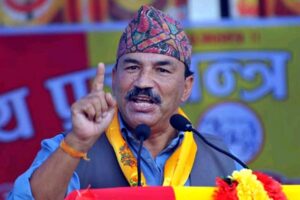
Kamal Thapa, who led the Rastriya Prajatantra Party after the abolition of the monarchy with a slogan of restoring the monarchy, has finally said he is now a republican.
Kamal Thapa, who has been nicknamed as ‘rat lawmaker’ by Lokendra Bahadur Chand in 1997 for frequently switching to the RPP (Chand) and RPP (Thapa) in the hope of becoming a cabinet minister, has again revealed his true nature. Until he was leading the RPP, he posed himself as a true ‘royalist’ but when he lost the election of party chair to Rajendra Lingden, he first accused the former king of playing a role for his defeat, later he quit the party and said he is now a pro-republic.
Kamal Thapa is greedy for power, he can take any decision to reach power. While raising the slogan for the restoration of the monarchy, he became Foreign Minister in the KP Oli-led government in 2016. He was even preparing to join the Oli-led government in June last year, but the Supreme Court verdict shattered his hope. Now when he lost elections, he became a republic, and it will be no wonder if he joins the UML in the hope of winning the parliament elections from Makwanpur in the backing of the UML.
On February 8, Thapa had declared separation from the party. Earlier, he had promised not to breach the party by touching the Gita, the holy book. But now again he quit the party leading a mental division in the RPP. With the exit of Thapa and his loyal, the RPP has become weak again.
Amidst political uncertainty, Election Commission preparing for local elections

The Election Commission has started making preparations to hold the local elections on May 13.
Although there is uncertainty whether the local polls will be held on the slated date, the election body has already decided to begin party registration from February 17 targeting the local polls. It has also prepared a 68-point election schedule.
Likewise, the Election Commission has decided to make the day before the upcoming local elections as the cut-off date for the young voters to complete their 18 years of age in order to make them eligible for voting the next day.
This means any Nepali citizen completing 18 years of age on May 12 can vote in the local level elections slated for the next day, May 13, 2022.
A Nepali citizen can obtain a citizenship certificate after completing 16-year age but voting rights could be exercised only after completing 18 years.
According to the ECN, this provision is being implemented for the first time in Nepal’s election history. It will ensure the voting rights for the additional 200,000 youth. The total number of voters on May 12 will be 17.9 million.
In the earlier elections, the election management body used to take the day on which the government announced the election date as the cut-off date.
However, the impeachment against the Chief Justice and the MCC dispute has now spoiled the election environment.
There are other challenges before the EC to hold the polls. It has estimated Rs. 12 billion to conduct the polls while the Nepal Police, Armed Police Force and Nepal Army each need at least Rs. 12 million to buy logistics and maintain peace during the elections. It means, at least Rs. 50 billion will be needed for the local polls. But the government may not be able to manage the fund at a time when the economic indicators have been negative.

Login to add a comment