








By Our Reporter
Prime Minister Sher Bahadur Deuba is determined to endorse the Millennium Challenge Corporation (MCC), the grant of an agency of the United States government, from the parliament by February 28. He has intensified exercises to take the MCC to the parliament and get endorsed.
In a bid to table MCC in the House, Prime Minister Deuba Sunday held a meeting with top leaders of the key ruling and opposition parties.
The MCC compact was signed by the Nepal government on September 14, 2017 for a US$ 630 million project, with $130 million investment from Nepal, to develop the cross-border transmission lines and rehabilitate the strategic roads.
During a two-hour meeting held at the Prime Minister’s official residence in Baluwatar, PM Deuba asked main opposition CPN-UNL chair KP Sharma Oli for help to forward the compact. CPN (Maoist Centre) chairman Pushpa Kamal Dahal was also present in the meeting. CPN-UML general secretary Shankar Pokharel and Minister for Communication and Information Technology Gyanendra Bahadur Karki, who had signed the MCC in the capacity of Finance Minister in 2017, were also present in the meeting.
According to UML general secretary Pokharel, during the meeting, the Prime Minister viewed that the help of the main opposition party was essential to push forward the MCC and other issues.
In response, UML chair Oli asked the ruling alliance to be clear first about the MCC, Pokharel said.
Oli said the UML would make its view clear about the MCC once the ruling alliance came forward with a clear view.
However, Maoist Centre chair Pushpa Kamal Dahal Prachanda proposed to forward the MCC only after elections.
Although the meeting failed to take any concrete decision on MCC, the government initiated a process to table the MCC in parliament. Immediately after the meeting, Minister for Law, Justice, and Parliamentary Affairs Dilendra Prasad Badu met Speaker Agni Prasad Sapkota and urged the latter for tabling the MCC compact in the Parliament. Minister Badu informed that the government was ready to table the compact in the parliament in the upcoming meeting that was scheduled for February 9. Speaker Sapkota, to avoid MCC, has postponed the Parliament meeting called for February 9 again by issuing a notice at midnight.
However, the UML in the Baluwatar meeting clearly said it would continue House obstruction until the 14 lawmakers of their party were punished.
As such, it is uncertain whether the Speaker allows tabling of the bill when the UML will continue to obstruct the House. UML wants the departure of the Speaker for smooth functioning of the House, which looks impossible. If Speaker is impeached, it will break the coalition which all NC, Maoist Centre, and the CPN (Unified Socialist) do not want. Unless Dahal makes a U-turn and convinces the Speaker as he has mentioned in his letter sent to the MCC chairman on September 29, 2021, endorsement of the MCC looks impossible.
Fate of the five-party-alliance
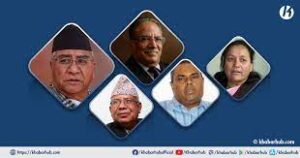
Photo: Internet
Nepali Congress president Sher Bahadur Deuba has been leading a coalition government of five political parties after the Supreme Court nullified the dissolution of the House in July last year, which culminated in the ousting of the KP Oli-led communist government.
Since then, the main leaders of the five coalition parties, Nepali Congress, CPN (Maoist Centre), Janata Samajwadi Party-Nepal, CPN (Unified Socialist), and Rashtriya Janamorcha have been reiterating almost every day that the coalition will continue until elections. Continuity of the coalition is more important for Madhav Nepal-led CPN (Unified Socialist) because if his party contests elections alone, he may not win even a single seat. The situation of Pushpa Kamal Dahal is also no different.
However, the dispute over the Millennium Challenge Corporation (MCC) has started shaking the foundation of the coalition as the Maoist Centre and Unified Socialist are against the MCC.
However, Prime Minister Sher Bahadur Deuba managed to announce the date of the local elections although both Dahal and Nepal were not ready for the elections. It is said that the two communist leaders agreed to hold the local level elections on May 13 after PM Deuba assured them to continue the present coalition till the elections. Even NC leader Ram Chandra Paudel has been stressing the need for the continuity of coalition. Recently, Paudel said in Pokhara that NC would not win elections if all the anti-NC voters, which he said were 70 percent of total voters, stood together.
But Dr. Shekhar Koirala, NC vice president Dhanraj Gurung and general secretary Gagan Thapa are against the coalition. As Dr. Koirala, though he lost the election of party president to Deuba for technical reasons, enjoys popular NC voters, Deuba may find it difficult to continue the alliance without convincing Koirala, Gurung and Thapa.
But the ground reality, especially in mountainous rural areas, is otherwise. Despite the split, UML is still stronger than other parties in the mountains and hills. Even many NC leaders close to Koirala admit this. As such, an election alliance looks important for the NC to win the elections.
Although at local levels, the candidates make difference, in parliamentary elections, alliance plays a key role in the defeat or victory of the party included in the alliance. In 2017, UML won most of the parliamentary seats because of its alliance with the Maoist Centre. And if the five parties forge a similar alliance in the upcoming elections, they can sweep the elections, because, in many seats, the NC lost the 2017 general elections to UML or Maoist candidates by less than 4,000 votes. Moreover, the split in the UML could be costly for the UML if the five parties file common candidates as they did in the recently held National Assembly elections.
Surely, if the five parties forge an election alliance, they will succeed to win more than two-thirds majority in the first-past-the-post election system of the House of Representatives. However, NC will be the loser while Maoist Centre and Unified Socialist will take advantage of such alliance. They can win even in the constituency where they are weaker than NC. But if they do not forge an alliance, such seats will go to the UML candidates.
As a win matters more than the votes garnered in the election, an election alliance will be crucial in a country like Nepal where winning majority seats by a single party in the House of Representatives is almost impossible because of the mixed election systems.

Login to add a comment