








By Zhou Shengping
On the first day of the last month of 2021, while attending the celebration of the Society of Economic Journalists-Nepal (SEJON) for its silver jubilee event in Kathmandu, Prime Minister and Nepali Congress President Sher Bahadur Deuba urged foreigners to invest confidently, promising the government would take all possible efforts to make an environment conducive for local and overseas investments.
Around one month back, leading a Nepali delegation to attend the World Leaders’ Summit in the 26th Conference of Parties (COP26) held in Europe, the PM did the same, calling for foreign investment from foreign lands to Nepal whose economy is facing grave challenges partly caused by the endless COVID-19 pandemic.
 At the same time, China and the Chinese seem to be taboo words for the five-time PM who rarely talks about them publicly. One case is his interview in one leading Nepali daily when the government under his leadership completed its 100 days in office in October.
“There is only one sentence talking about China, his attitude towards China is very cold,” said a Chinese scholar who has been following closely Nepali affairs for a long time.
What is the relationship between Nepal’s foreign investment and China? According to the Department of Industry, China had topped in the foreign direct investment (FDI) commitments for six years in a row.
In the first three months of the current fiscal year starting on 16 July, Nepal received a total of 23.71 billion Nepali rupees in FDI commitment, among them 21.91 billion was from China, said Xinhua News Agency recently.
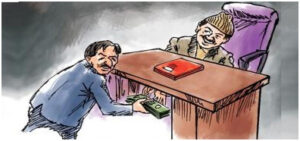
China contributes 92.4% FDI commitment to Nepal, does China deserve special attention from PM Deuba? The answer “Yes” or “No” probably doesn’t matter, what haunts all investors from China is the corruption, which is like an immeasurable tree, deeply rooted in every nook and cranny of this Himalayan nation.
During the time when a new government meets an old one, corruption is especially rife thanks to the outgoing people in power who don’t want to give up the last chance to get rich.
Once one Prime Minister was bound to step down from power soon, his aides and close circle started demanding hefty amounts from Chinese investors.
Quite a few times, Chinese friends asked a middle man to help them in bringing some mega projects to pass through. The answer from the close circle of PM was clear that all difficulties would be ironed out, and in return, they needed min of money to help them with a couple of things like elections.
The paying back plan was sought immediately instead of understanding more about the projects and their outcomes. I knew about the commission game in Nepal but had never expected that it would be in such a clear and frank manner.
Their logic looked both simple and innocent: if leaders could enjoy a comfortable living with easy money, they would support the project in long run enabling higher revenue from the project to the investors. In such a way, the investors were compelled to pay a huge amount to execute their projects.
“Who is the most corrupt politician in your country?” I asked a Nepali friend who boasted of learning about lots of dirty deeds.
“It is very hard to answer. Some figures are considered among the most corrupt, but they win the bad name only because they are bad at managing corruption.”
To seek illegitimate interests is an open secret. I remember a Nepali journalist friend sharing that almost every officer wants only money from China, without caring about getting back lessons, skills or technical know-how for his or her own career growth and national interest.
As far as the projects under the Chinese Belt and Road Initiative are concerned, Nepal hasn’t been able to harvest much till date. According to the critic, corruption is one of the greatest banes because leaders and officials are focused only on how much they will get from the north for themselves to strike it rich, but not on how much the country could get from the projects.
An entrepreneur from Sichuan, China, who has been living in Nepal for the last seven years, was frustrated with the local government system. She wanted to lease a small piece of land to do organic farming for her food-based industry. The project would generate local employment opportunities which could support the livelihood in the rural community.
When she approached the local authority, she was asked to pay a half-million Nepali rupees as a commission just for a small signature. She was shocked but was still ready to pay around two lakhs, which was denied by the greedy ward chairman. As a result, she had to relocate her overall farming plan to a nearby village, where she offered less than two lakh rupees bribery fund to get the signature.
The suffering she shared with this writer was echoed by many other Chinese nationals who wanted to invest and set up any business in Nepal.
“What is your suggestion for Chinese investors targeting Nepal?” I once asked one Chinese friend who started his business here in 2009.
“Don’t invest!” “It is risky!” He blankly answered me.
As the owner of a consulting company, his daily job is to frequently contact government officers for different procedures to serve his Chinese clients who run big projects in Nepal. This veteran businessman finds it very difficult to get timely and professional service from these offices through normal channels and only bribes can push those civil servants to fulfil their duties.
A useful suggestion from another old hand at investment for his Chinese colleagues is to be patient while abiding by the laws.
To get one export certificate from the Nepal government, he spent many years. After all, documents were submitted to the last decision-maker in the office this year, nothing happened for a few weeks. His instinct told him that somebody was waiting for some special money, but the one-decade working experience here reminded him that the officer must sign even without any bribe. After three months of waiting, he finally got it without extra payment. He said he would have to sacrifice at least one million rupees hush-money if he was a green hand.
Corruption is unchecked cancer for a healthy society, an enemy of development and good governance, a horror for foreign investors. In this sense, people like the newly appointed Chief Minister of Bagmati Province Rajendra Prasad Pandey are endangered animals with good conscience. The CM said on 30 October that the utmost priority of the provincial government was to curb corruption.
Zhou is the former Bureau Chief of the Chinese news agency Xinhua in Nepal.

Login to add a comment