








By Narayan Prasad Mishra
K. Krishna Menon is one of the great men of India for his knowledge and oratory. He is considered the architect of the nonaligned movement and the second most powerful man in India during the Prime Minister Jawaharlal Nehru. He was the first Indian High Commissioner of India to the United Kingdom in 1947, just after its independence, and was the Indian defense minister under Prime Minister Nehru. He is notably remembered for his marathon speech on Kashmir in the United Nations Security Council in 1957. According to Guinness World Records, the longest statement made at the UN was given by V.K. Krishna Menon of India. According to the times listed on the meeting records, the meeting lasted more than 8 hours. I had an opportunity to see him and listen to him when he delivered his speech at Jubilee Hall, the Student’s Hostel at the University of Delhi, in 1966 when I was a student at the University. When the movement to make the Hindi language the official National language was at a high peak, one pro-Hindi Jana Sangh Hindu nationalist activist student asked him the question in Hindi. There was a hue and cry against it. Suddenly the situation was in a clash. He permitted the student to ask him in Hindi. The student made a long question like a speech in Hindi. After the student’s question, Menon answered that he did not understand his question. There was a burst of big laughter. He is a man who once expressed the following view on biography and autobiography.
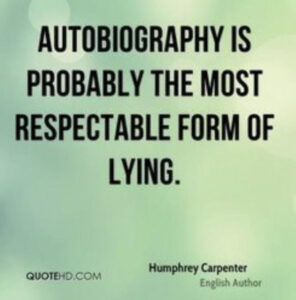
Autobiographies are written by those who think the world moves around them, and biographies are written by those who have nothing special things to do. He neither wants to write an autobiography nor intends to be written his bio.
George Bernard Shaw, a well-known British writer, once said that when you read a biography, remember that the truth is never fit for publication. When we analyze the nature of human beings, we come to know that people often hide their weaknesses and faults and like to present goodness and noble qualities even not possessed. I love to read biographies and autobiographies of great men of the world in different fields. But I always keep in mind the above points in my reading.
Though we did not have many biographies and autobiographies in Nepal, books on these areas increased daily. I recently read some of these books about the people I know personally. I know who they were, what they were, and their nature, mentality, and contributions. I know their family history not only by reading, by seeing, by experiencing. I know an autobiography writer whose father was an idol and statue smuggler who was in police custody from time to time. The man depicted him as a great social worker. Similarly, I know a politician whose father was a gangster and hooligan who looted the people all around and even tortured the wife for getting money from his father-in-law. He presented his father as a noble person. I know a man who gave his mother-in-law indescribable pain and trouble when living. The same person was depicted as the most devoted son-in-law by someone in his biography. I read an autobiography of a justice of a court as a holy and pure saint to whom one of my friends had to bribe to go to his residence for a court case. When I see this, the facts and descriptions are different from reality, I often think autobiography and biography is the mesh through which real-life escapes, as Tom Stoppard, Czech-born British playwright and screenwriter, said.

Login to add a comment