







In memory of B.P. Koirala-2

By Narayan Prasad Mishra
We all think the Nepali Congress Party, the party of democracy, and the party of Bishweshwor Prasad Koirala, determined to stand for freedom of speech, writing, and various fundamental and human rights, socialism based on Nepali culture and tradition, including constitutional monarchy, Hindu religion, and democracy. That is what the party was different from other parties and mainly from the Communist Party. We all know B. P. Babu stood firmly for these causes even when he was imprisoned by the then Kings as if he was a political saint, not even moving an inch from his stand. That stand was not easy to make your culture for an ordinary person. We see a regular person primarily has an ego and an attitude of revenge, whereas the great men do not think of it and always stand for truth and the right path. Because of his greatness and holy spirit, it indeed established him as an extraordinary political saint.
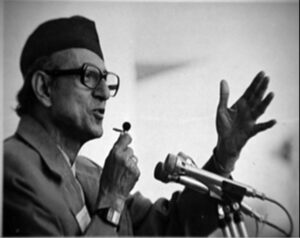
I remember him mostly with much appreciation for his three sayings and stand as follows.
- We all know King Birendra announced a referendum to choose between the Panchayat system and multiparty democracy in 1979 after the political unrest. The parties, which were for a multiparty system, stood on one side. So the Nepali Congress Party and several other parties, including communist parties, stood on one side. On the other hand, the Panchas who were for Panchayat system stood another side. They started campaigning to mobilize the people for their cause. Man Mohan Adhikari, the well-known leader of the Communist Party with his colleagues, requested B.P. Babu for a joint campaign program for their common cause – a multiparty system. B.P. Babu did not agree with it and said that though the cause was common, they were different parties with different political philosophies. So the people who would come to listen to him would come to have his saying, political views, and philosophy. They would be his people who were for him and his party. In the same way, the people who liked communists would go to have their views to their gathering. That is why he did not want to share and mixed up his followers, his audience with other parties. The Nepali Congress Party did their campaign separately, and the communist did separately. That was the unforgettable stand of a democratic leader not to be polluted from other political philosophies, not thinking of temporary gain and loss.
- When the referendum result was out, it showed that the Panchayat system won the referendum. That was unbelievable for multiparty followers. There was a big rumour of rigging. The other party leaders and his colleagues wanted to voice against it. But he took his stand and said he would accept the result as he was the true democrat and participated in the referendum. It would be undemocratic to speak against it after participating in the play. Admirable.
- The third thing he said was that his democratic principle and kingship crown are correlated, unseparated, inter-linked. His belief that one would not exist without others, saying that his throat and the king’s throat are joined together. When you see the political scenario of this country today, it seems he was absolutely right in his thinking. It appeared he was an enlightened and far-sighted leader. Nepal became a republic when the Nepali Congress Party separated from the earlier stand of Constitutional Monarchy and derailed from its earlier perspective.
Similarly, after Nepal became the republic, the influence on the people of the Nepali Congress Party is deteriorating, and on the other hand, the impact of the communists is increasing. The almost two-thirds majority of the communists in the last election established this fact. If the communists are united, the situation will probably be the same because the people do not find any distinct difference in political philosophy and culture between the present Nepali Congress Party and the communist parties.
Not only that, one could discover the extraordinary difference between B.P.’s Congress Party and today’s Congress Party just from a point mentioned above that B.P. did not join with communists for a campaign, even for a common cause in a referendum. Today we see the Nepali Congress Party and the Communist parties have been sharing everything, including the government. Their main aim seems to enjoy power by any means. B.P’s beloved brother and right-hand person, like Laxman to Lord Ram, Girija Prasad Koirala, started bhagabanda politics in Nepal derailed from his democratic principles even sharing the parliament with bhagabanda philosophy when he came to power. His brother Girija became the father and mother of bhagabanda politics in this country. In this context, we can well remember Girija presented 83 parliamentarian seats to the Maoist Party and made them parliament nominated members without an election in 2006. The tree of power-sharing (bhagabanda) he planted now became a massive tree-like Pipal tree. That tree gave birth to unlimited other bhagabanda trees. We have power-sharing (bhagabanda) in politics everywhere, from the universities to the planning commission. Our country has been reaping and picking the sour and bitter fruits of bhagabanda everywhere. The government is in a mesh. One who has unpolluted conscience can easily understand it.
Last time, my late wife Shanti Mishra, the first female professor of Tribhuvan University, and I met B.P. Babu in the American Embassy at a party in 1980. That was just after the Referendum result. All the dignitaries of our country except the Royal family were present there – prime minister, ministers, and leaders and high officials. The Panchas were there in a happy mood. The living among invitees who attended that gathering should remember that reception well. We were also lucky to be in that gathering to observe the scene. When B.P. Babu arrived, he became the center of attraction. When I saw his dignified personality, draw, and response from all the people and people of power there, it seemed he was the winner, not the loser of the referendum. We went to greet him to his near. We got his affection as usual. We both asked him what he would do now as the multiparty lost the election. I vividly remember he said everyone blaming him for the loss and asking him not to accept the result, but he would not do so as a democrat. He was thinking of spending some time reading and writing. He wanted to come to the library regularly. At the same time, he asked us whether we could arrange a separate cubicle for his study in the library.
We were so happy to hear it and requested him to come and said we would do anything to comfort his study and research and provide tea with joy and happiness prepared from our own hands. He was happy to see our joy, love, and respect. He smiled. While we were with him Dr Tulsi Giri, the Panchayat hero, entered and came directly to him to greet him. He asked him in Hindi, “How are you” (Kaisa Hai)! Dr Giri said OK. That was when some photographer took a snap, and that our picture with B.P. and Dr Giri was published in some Nepali newspaper published in Kathmandu the next day. At that time, I did not care about that, which could be an interesting historical picture to include in this article. So I do not have that paper with me and do not remember which paper it was. If I could check all the Nepali newspapers of that day in Madan Puraskar Pustakalaya, I could probably find it. In this context, I want to request the editor of that unknown paper to provide me with a copy of that picture if he happens to read this article.
We were hoping to welcome B.P. Babu, our beloved respected leader in Tribhuvan University Central Library as he wished and we wished. But it disappeared like a dream from us. He vanished from us before he made it. We never saw him in the library. My beloved wife is no more in this world now. But I remember him from time to time with respect and love. I considered him a great leader from all aspects, especially his stand of democratic principles in any circumstances. We all consider him the towering figure of Nepalese politics. More than that, I consider him a holy saint of democratic principles who will be remembered forever by his friends and foe equally. As Martin Luther King, Jr., the internationally known Black Leader (Afro-American) of the USA, once said in his speech, “We should not be guilty of wrongful deeds in the process of gaining our rightful place”. B.P. Babu was firm and stable like a tall mountain not to step the wrong path for getting the power and position. So he did not want to remove the kingship, which he thought was a necessary institution for the country though he suffered a lot from the then kings. That was his greatness we all should learn. As the proverb says, “A beautiful soul will never be forgotten” I am sure he will always be remembered with love and respect. I pay my deep respect to him wherever he is on the occasion of his memorial day. Pranam to B.P. Babu. I miss you. I wish and pray your party leaders and followers follow your life and teachings for the welfare of the people and the country’s development, not only being ritualistic like some religious people who perform big puja with delicious varieties of prasad (offering of fruits, sweets, and good dishes) but not follow the preachings of Lord Krishna, Bhagawan Buddha, or Jesus Christ.
narayanshanti70@gmail.com
Mobile-9841401841

Login to add a comment