







View from America

By M.R. Josse
GAITHERSBURG, MD: As the Biden administration crosses its first six-month mark, a brief review of the domestic and international landscape that the United States confronts may be in order. Domestically, it may be fair to say that the United States has entered an era of democratic dysfunction, with American democracy coming across as increasingly – and uncharacteristically – endangered.
Indeed, those gloomy conclusions were the over-arching concerns of Fareed Zakaria’s 1st August 2021 Global Public Square (GPS) programme on CNN, even as America’s once-exemplary rate of Covid-19 vaccinations has now stalled with about 40 percent of the population still unvaccinated.
DEMOCRATIC DYSFUNCTION
In fact, the latter explains why President Joe Biden finally moved to make vaccinations mandatory for federal employees, including military personnel, besides triggering a whole slew of imaginative incentives for the same by others, including doling out $ 100 per person for acceptance. As the United States presently stands, it’s a long way to ‘herd immunity’ whereas Israel has recently claimed it has reached that desired public health Utopia.
Significantly, in the meantime, one increasingly hears suggestions of a future ‘booster’ dose being required for those who have had the requisite two shots of the vaccine more than six months ago. According to some experts, the immunity that the vaccination ensures apparently wanes after a period of six months or so following the jabs.
Though official approval for ‘booster’ shots has not been forthcoming, at this stage at least, it could very well be the norm before the summer is over. In any case, it is worth noting that, to mention Israel once again, people who are over 65 years of age and who have taken Covid-19 vaccinations more than five months previously are presently being inoculated with ‘booster’ doses.
As the experts explain it, today in the United States, the Covid-19 pandemic can be called a pandemic of the unvaccinated: while those who are already vaccinated are generally safe, with the deadly delta variant now sweeping across the country the populace cannot be regarded as completely safe until all people are.
As mentioned before, there is a distinctly American flavor to the resistance to the vaccination, mostly in states that are solidly Republican, and, even more so, where former President Donald Trump’s political base holds sway.
This brings me to a write-up by CNN’s Stephen Collinson, 2 August, where he argues that Trump holds out a $ 100 million threat to democracy. “Donald Trump now has a $ 100 million weapon to wield against U.S. democracy. The defeated and disgraced former President’s huge war chest, nearly all amassed within six months of leaving office, was built on his ravenous calls for cash from supporters bought into his delusional lie that the 2020 election was stolen. It is the latest sign, along with a trip to win his favor by GOP candidates and his party’s incessant effort to wipe the history of his crimes against the Constitution, that Trump’s threat to basic political freedom is far from over.”
Such threats are likely to grow in the months ahead, says Collinson. He avers that the past week’s new revelations about his efforts to pressure the Department of Justice (DOJ) over the election he lost and, even more disturbing, the horrific details of the 6 January attack on the U.S. Capitol that emerged in the House select committee’s first hearing has “clarified the history of Trump’s bid to destroy the U.S. political system.”
Days earlier, the BBC also disclosed that the DOJ ordered the Internal Revenue Service to hand over Donald Trump’s tax returns to Congress, delivering a sharp blow to Trump by doing so. Although not required by law, every American president since 1976 – except Trump – has released their tax return. While Trump had still to comment on the same when going to press, Republicans on Capitol Hill denounced the DOJ decision, describing it as politically motivated.
The surprisingly frail state of American democracy was reflected in other ways, as well. Indeed, as per CNN’s Annie Grayer, tension in the House had boiled over after the 1/6 hearing and mask rule. As she reported it, in the House, over the past two weeks, the focus on the tense dynamics there has only worsened. Indeed, the creation of the select committee to investigate the 6 January riot, which pitted House party leadership against each other, has “infused a level of rage through the hallways of the House that has poured gasoline on an already scorching working relationship.”
TALIBAN REPERCUSSIONS
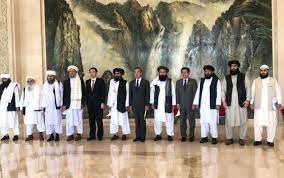
Chinese Foreign Minister Wang Yi meets a Taliban delegation visiting China. Photo: Internet
On the international front, the American dilemma is sharply underscored by the rapid developments on/regarding Afghanistan, from which the Biden-ordered withdrawal of military forces is fast drawing to an end. Specifically, it is manifested not only in the aftershocks of the Taliban’s swift military victories in Afghanistan but, arguably even more so, in the politico-diplomatic-geopolitical waves/turbulence that it has set off in the region.
The latter phenomenon has been dramatized most of all by the attention-grabbing visit of the Taliban to Tianjin, in China, which prompted a South China Morning Post editorial, 1 August, claiming: ‘For China, engaging with Taliban makes sense’.
The editorial reminded, inter alia, that “with the U.S. withdrawing and the Taliban having seized swift control of about half of Afghanistan, few people give the Afghan government much chance of survival. September may be the decisive month when the withdrawal is completed and the American air operations against Taliban positions end.”
That, the journal surmised, is behind Chinese Foreign Minister Wang Yi’s “unusually high-level reception to a delegation of Taliban leaders in Tianjin, in the same room where he met U.S. Undersecretary of State Wendy Sherman just the other day” – in fact, just as U.S. Secretary Antony Blinken was due to arrive on a maiden official visit to India.
Another noteworthy diplomatic jaw-jaw session that can be sourced to the Taliban’s recent resurgence is the recent one in Washington to discuss Afghanistan, between Dr Moeed Yusuf and Jake Sullivan, the Pakistani and American national security advisers.
As per a news report in Dawn, 1 August, the two “discussed the urgent need for the reduction in violence and a negotiated political settlement in Afghanistan,” quoting Sullivan. As per a tweet by Yusuf, the two interlocutors “agreed to sustain the momentum in Pak-U.S. bilateral cooperation.”
Days earlier, as per Dawn, Pakistan Prime Minister Imran Khan had declared that the “U.S. really messed it up,” even as he questioned the American motive in invading Afghanistan in the first place and then their “subsequent attempts of seeking a political solution with the Taliban from a position of weakness.”
Khan made the comments at an appearance on PBS NewsHour, an American news programme, 27 July. He slammed the United States for trying “to look for a military solution, when there never was one.”
Incidentally, arguing that “Pakistan’s security is inextricably tied to Afghanistan”, noted former Pakistan diplomat Maleeha Lodhi declared in Dawn, 2 August: “As concerns grow in Pakistan about the fallout of the deteriorating security situation in Afghanistan, protracted fighting that morphs into civil war will pose severe dilemmas and multiple challenges for the country.”
While this columnist last week offered some observations on Chinese President Xi Jinping’s recent three-day official visit to Tibet and briefly commented on Blinken’s two-day official mission to New Delhi, around the same time-span, here he wishes to make a few add-ons.
With respect to Xi and Tibet, I merely wish to draw attention to a recent story in the South China Morning Post by Jun Mai and Mimi Lau explaining what they thought the “message” that Xi was sending by his Tibet sojourn was.
Briefly, they believed it had basically a two-fold purpose: to send a message to the U.S., India and the Dalai Lama by his visit to Tibet; and, specifically, by his trips to leading Buddhist monasteries, including Drepung, to highlight Beijing’s grip on the region.
As per the Indian Express, Indian Foreign Minister S. Jaishankar, after his meeting with Blinken, 28 July, spelling out the red lines on the Taliban issue, declared that the outcome should not be “decided by force on the battlefield” and that it should be free “from malign influences” – an obvious reference to Pakistan.
According to The Print, 28 July, India even criticized the meeting the previous week on the China Pakistan Economic Corridor in Chengdu, Sichuan between Pakistan Foreign Minister Shah Mohammad Qureshi and Chinese Foreign Minister Wang Yi!
Even more telling was the news item in Asia Times, quoting the South China Morning Post, informing that Blinken met with a representative of the Dalai Lama, in New Delhi, 28 July, in a meeting with a group of civil society leaders.
UNCERTAINTIES, IMPONDERABLES
Even from the above sketchy account of the unusual mix of inter-meshing diplomatic-political happenings, particularly relating to the Taliban/Afghanistan and relations between India, China, Pakistan and the United States – it would seem reasonably clear that the region encompassed in the aforementioned discussion is currently loaded with a mass of inflammable uncertainties and imponderables, including those imbued with a strategic nature.
While it thus stands to reason to exercise utmost caution before leaping to overly dramatic or hasty policy conclusions, I believe that those who follow the ebb and flow of the main currents of international relations must not – on the other hand – allow themselves to be blindsided and naively assume that matters in the theatre of interest/engagement alluded to above are quite normal.
In particular, this columnist wishes to direct attention to a consensus that seems to have emerged on one of the most critical issues dominating contemporary international affairs: the steadily deteriorating relationship between the United States and China.
To quote CNN’s Hong Kong-based Ben Westcott and Nectar Gan, 30 July: The U.S. and China say they want to avoid military conflict, but no one can agree on how.
“Among the recriminations and accusations, there was one point on consensus where American and Chinese diplomats met in the coastal city of Tianjin, earlier this week: But there was little consensus on a concrete way to avoid that catastrophe. And that has the experts worried.”
Even for non-experts such as yours truly the fact that both Biden’s get-tough-on-China policy and Xi’s equally assertive counter-America policy have garnered significant support at the domestic level in their respective countries makes things more serious. After all, as the saying goes, when elephants fight, it is the grass that gets trampled for sure.
BALANCE – OR ELSE

Prime Minister Sher Bahadur Deuba taking the oath of office. Photo: Internet
The fact that, at home, the Deuba-led coalition is, at the time of writing, still not fully formed is not only an inauspicious sign per se; it is certainly not a good omen for the smooth conduct of Nepal’s foreign policy which, since the days of yore, has rested on the principle and reality of maintaining the geopolitical balance of power in Nepal, in particular between geostrategic pulls from the north and the south.
It is to be hoped that the Deuba government does not forget this cardinal fact of Nepali history. It will be most salutary for the powers that be at the helm of affairs in Nepal today to remember that. While it is important that Nepal continues to pursue cordial and mutually advantageous relations with India and the United States, she must never forget that such a policy cannot be pursued at the cost of China, now a global power in her own right, particularly in all matters bearing upon her autonomous Tibetan region, to Nepal’s immediate north.

Login to add a comment