







Political Commentary
 By P.R. Pradhan
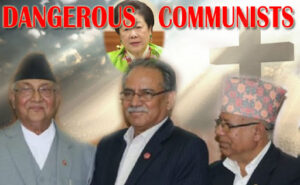
Presently, we are watching the battle between the Indian establishment verses Indo-West (pro-Christian) in Nepal. With the covert support of the pro-Christian Indo-West block– comprised of those officials in the South Block and RAW serving the previous government including Shyam Sharan, who had formulated the 12-point agreement in 2005 and westerners who were active in campaigning for Christianity in Nepal — a front against outgoing prime minister K.P. Sharma Oli was developed in the country. The one-point agenda of the united front was to topple down Oli from the chair. The front has become successful on its mission.
The Supreme Court, by asking the President to assign Sher Bahadur Deuba to the post of the PM, has served the Indo-West strategy. It means, the group serving the previous government in India is still strong in Nepal. Those senior diplomats (now retired) working at different capacities in the South Block during 2005 had written a series of articles in different newspapers in India predicting that the policy initiated by them on Nepal was appropriate. They had urged the BJP government in India for not discarding the force that emerged on the base of the 12-point agreement and for supporting the structures established on the base of the 12-point agreement — republicanism, secularism, and federalism — which is in the greater interests of India, they had predicted. Sharan had further predicted that abolition of the institution of monarchy was a big achievement for India.
BJP supports K.P. Oli:
Of late, when K.P. Oli felt a series of hurdles from his own colleagues in the party, he thought about developing better relations with India by ending all the past differences. Earlier, since Nepal sent the diplomatic note claiming the Kalapani as Nepali territory and later protesting against the construction of a road to the Chinese border passing through the Nepali territory, the relations between Nepal was turned into a no-talking term. The diplomatic relations between the two countries became very worst after the parliament approved a political map incorporating the Kalapani territory. Oli decided to bow down in front of India by forgetting all the past stances taken by him against India.
Indian RAW chief Samant Goel landed in Kathmandu at the special invitation of Oli. The visit broke the ice in Nepal-India relations. He was offered a red-carpet welcome at Baluatar, PM’s official residence and Oli held a one-on-one talk with the RAW chief. It is said that Oli, during the talks, had expressed commitment to addressing all the Indian concerns including curtailing the increasing Chinese and Western presence in Nepal.
Delhi had taken Goel’s Kathmandu visit as a successful mission. Following the Goel visit, Indian Army chief General Manoj Mukund Narvane and Indian foreign secretary Harsh Vardhan Shringla paid an official visit to Kathmandu. Also, Nepal’s foreign minister Pradeep Gyawali visited Delhi. In this way, the no-talking term between the two countries was ended.
When Oli sided with Delhi and tried to bulldoze his colleagues within the party, the Westerners and those individuals who had formulated the 12-point agreement, became worried about Oli’s possible further move of re-declaring Nepal a Hindu nation and scraping the federal structure.
The Indo-West lobby again became active against Oli even by developing a setting in the Court, according to the political observers.
In the course of heating the streets, a group of so-called civil-society members appeared in the street protest. Moreover, to defame the BJP intervention, five former prime ministers – Sher Bahadur Deuba, Madhav Kumar Nepal, Pushpakamal Dahal, Baburam Bhattarai and Jhalanath Khanal issued a joint statement opposing foreign intervention in Nepal. To note, all the five ex-PMs were indicating towards the BJP government for supporting Oli and intervening in Nepal’s domestic affairs. All four ex-PMs, except Khanal, are known to be the India confidants. India, however, didn’t express any reaction against the statement.
The Oli government has been toppled down and Sher Bahadur Deuba has become the new Prime Minister. He has been able to bag a two-thirds majority in the House of Representatives while taking confidence motion, which is an unexpected event for him. The majority exhibited in the House is artificial and after expansion of the cabinet, the number of votes that went in favour of Deuba will start declining. However, in accordance with the constitution, one cannot challenge Deuba at least for two years. In this regard, Deuba may lead the government until completion of the full tenure of the House, say one and a half years. Nevertheless, it is expected that Deuba cannot be able to present the government policy and programme and the budget for the next fiscal year as he will not be able to manage the necessary number to endorse the two important government agendas from the House. Therefore, it is expected, Deuba will announce the election and dissolve the House before presenting the government policy and programme next year. He may announce election dates even before it as he believes when the communists are divided, it is an opportunity for the NC to become the largest party in the federal parliament, provincial assemblies and local governments.
Future of the united front:
The tarai based Janata Samajbadi Party Nepal is divided into two factions. Clearly, Mahantha Thakur leads the group closed to the present Indian establishment, whereas, Upendra Yadav faction is closed to the Indo-West group.
Within a week of taking the oath of office by Deuba, Baburam Bhattarai, the JNU product and always serving the Indian interests, tried to defame Yogi Aadityanath, chief minister and a strong leader in BJP, by criticizing him for offering milk to the sun, which has not only hurt the Hindu followers. Bhattarai had tweeted stating that in the name of religious belief, they are encouraging for wasting milk and drinking urine.
In response to Bhattarai’s twit, Vijaya Chouthaile, Foreign Affairs Department chief of the BJP, has made a strong reaction. Chouthaile’s remarks cannot be taken as a baseless comments. How India’s ruling party is going to behave with the united front, which is even planning to contest elections jointly against the “regressive elements” in Nepal, it can be assumed.
In reaction to Bhattarai’s tweet hurting the Hindu belief, Bhattarai’s effigies are being burnt in different places.
According to Yubraj Ghimire, a political analyst, who is well aware of Indian politics, Bhattarai’s twit could be dangerous for him and Deuba, a partner in the united front.

Login to add a comment