







View from America

By M.R. Josse
GAITHERSBURG, MD: This week’s fare will serve a constellation or mixed-bag of issues and priorities that have dominated the past week or so here in the U.S. as well as in our own Asian bailiwick.
Let me begin with President Joe Biden’s America where, according to top infectious diseases expert, Dr Antony Fauci, the country is heading “in the wrong direction” on the coronavirus pandemic front, with infections surging among the unvaccinated even as the deadly Delta variant of Covid-19 is driving a spike in areas with low vaccination rates.
In fact, as CNN has just reported, cases in 48 states have surged by at least 10 percent, compared to the previous week. What’s more, at this stage, it is estimated that only 60 percent of Americans have been inoculated, marking a significant slowing down of what was a most impressive rate not too long ago. The point to be remembered is that although America has more than enough vaccination doses for the entire population, the prospects for further advances in this regard appear slim.
That must surely seem especially inexplicable or ironic to people in the developing world most of whom would readily give an arm and a leg to receive timely vaccination!
UNIQUELY AMERICAN
What’s more, the vaccination/pandemic landscape is surcharged with right-wing political conspiracy theories and theorists, led, in many cases, by politicians of the Republican stripe. Coincidentally, or otherwise, states with the lowest vaccination rates are precisely those that voted for former President Donald Trump during the 2020 presidential election – a uniquely American phenomenon, I dare say.
Of course, there are other notable singularities, including that the greatest degree of hesitancy vis-à-vis vaccines flourishes among those who are less educated and hence especially susceptible to willful misinformation disseminated by vested political interest through myriad outlets, including social media. To be sure, it hardly requires a clairvoyant to surmise that, over the near future, America is going to experience a sharp rise in Covid-19 infections, especially in areas with low vaccination.
It is thus somewhat perplexing why Biden, who won deserved accolades for the efficient and caring manner in which he tackled the Covid-19 crisis in the early days of his administration, now seems to be dragging his feet in dispensing urgent measures on the Covid-19 front.
Indeed, some well-known public commentators have called for such a course of action, including in mandating all members of the armed forces to be vaccinated.
Michael Smerconish, a popular CNN talk show host, the other day for example, specifically underlined the fact that Biden, as commander-in-chief, could mandate such a policy on grounds of national security. The commander-in-chief has, however, not done so; the various branches of the military are therefore far removed from a 100 percent record in Covid-19 vaccinations.
While there is never a dearth of topical issues that merit commentary/analysis, let me single out one that especially screams for attention. In short, this has to do with Trump and the Republican Party spinning fantasies to hide the former’s crimes against the constitution on 6 January, as credibly argued by CNN political analyst, Stephen Collinson.
To cut a long story short, as he informs, Trump insisted that the mob that marched from his rally on that fateful day to invade the U.S. capital was a “very loving crowd”, as per excerpts from audio interviews by two Washington Post reporters in a new book on Trump’s last days in office. Trump’s media propagandists have sought “not just to excuse the former President’s conduct but to comprehensively alter the facts and public perception of the worst attack on Congress in two centuries.”
Such a “shape-shifting strategy”, Collinson says, “isn’t just a political device – it allows those who promote it to avoid wrestling with the reality of an assault on American democracy.”
On the foreign policy front, meanwhile, as reported by BBC, the U.S. government has imposed sanctions on Cuban officials who they claimed had committed human rights abuses during a crackdown on political protests in Cuba earlier this month. The move by the Biden administration comes amid pressure from Cuban-Americans and politicians to respond to the anti-regime protests in Cuba.
PRAGMATISM AND CAUTION
In a statement, Biden explained, “This is just the beginning…The United States will continue to sanction, individuals responsible for the oppression of the Cuban people.” What’s notable is that Biden chose not to go much beyond sanctions, reflecting pragmatism or even caution on his part.
Pragmatism or caution indeed appear to be the hallmarks of Biden’s overarching Afghan policy, too, as the process of withdrawal of American military forces from Afghanistan nears completion. That it is, however, not apparently producing the intended consequences appears to be underscored by the fact that that civilian casualties in Afghanistan are presently at a record level, at the first half of 2021, according to a new UN report.
As the BBC informs, civilian deaths in Afghanistan have crossed the more than 1,600 mark – a rise of 47 percent compared with the same period last year.
Another gruesome metric vis-à-vis Afghanistan was provided by CNN’s Sandi Sidhu, Anna Coren and Helen Regan, who, the other day, recounted eye-witnesses account to the Red Crescent on how Sohail Pardis, a U.S. army interpreter, was dragged out of his vehicle and beheaded by the Taliban.
In any case, it is significant that, as reported by Timesofindia.indiatimes.com, 20 July, U.S. Secretary of State Antony Blinken’s maiden two-day trip to India, according to sources quoted by ANI, will take place 27-28 July.
Though no official disclosure of the same has been made at the time of writing, there is no reason to doubt that Blinken will indeed land in Delhi soon; he would be the second senior U.S. official to do so, following in the footsteps of U.S. Secretary of Defense Lloyd Austin.
I believe even a duffer can fathom that one of the main items on Blinken’s India agenda would be Afghanistan – or, more precisely, India’s role there in the eerie aftermath of America’s virtual exit from that super strategically located South/Central Asian landlocked nation where India’s massive investments – economic, political and diplomatic – in the post-2001 era seem to have been flushed down the drain.
That having been stated, let me draw attention to an opinion piece in the Hindu, published on 22 July and penned by Happymon Jacob, who recommends that “India must directly deal with Taliban 2.0”. The central thrust of the write-up is that “the time for hesitant backchannel parleys is over and New Delhi has to begin ‘open talks’ as it is a strategic necessity.”
Jacob believes that for India to stay relevant in the unfolding ‘great game’ in Afghanistan, and to safeguard its remaining assets, she will have to deal face-to-face with the Taliban. “It makes neither strategic nor economic sense to withdraw from Afghanistan after spending $ 3 billion,” Jacob argues.
While on the twin themes of Afghanistan and the Taliban, it was edifying to note that, as reported in Dawn, Zahid Hafez Chaudhri, official spokesman of the Pakistan Foreign Office, conveyed Pakistan’s serious concerns to Afghanistan regarding recent “irresponsible statements and baseless allegations made up by the Afghan leadership against Pakistan with respect to its relationship with the Afghan Taliban.”
Dawn reminded that the Foreign Office statement came days after Afghan President Ashraf Ghani – in an interview with German magazine Der Spiegel – claimed that Pakistan “operated an organized system of support for the Taliban” underlining the politico-diplomatic complications inherent in the rapidly unfolding Afghan crisis.
XI IN TIBET
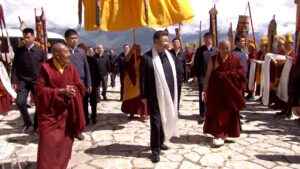
Chinese President Xi Jinping in a visit to Tibet, China, last week
While Blinken is very possibly arriving in India as this essay sees light of day, his colleague, Deputy Secretary of State, Wendy Sherman, will be completing a two-day official visit to China’s northeastern port city of Tianjin where she held talks with China’s Vice Foreign Minister Xie Feng.
As per a BBC report, 26 July, Xie issued a strongly-worded statement towards the United States, declaring that relations between the two countries had reached a “stalemate” because the United States saw China as an “imagined enemy”.
He directed that comment to Sherman, the most senior American official to visit China since Biden assumed office. Xie said that the U.S. wanted “to blame China for its own structural problems”, according to a statement by the Chinese Foreign Ministry. “It is as if when China’s development is contained…America would become great again,” Xie declared.
BBC did not report on what Sherman’s response to Xie was; it did, however, informs that Sherman’s China visit is widely being viewed as a preparatory step for an eventual meeting between Biden and his Chinese counterpart, Chinese President Xi Jinping.
Even more significant was the internationally not-well-publicized recent visit to Tibet by President Xi. The BBC, 23 July, however, reported on it saying that it was the first official visit to China’s Tibetan Autonomous Region (TAR) by “a Chinese leader in 30 years.” It last lasted from 21-23 July.
As the British news outfit informed, Xi first arrived in Tibet in Nyingchi in the southeast of that territory. He then proceeded to a number of other locations to learn about urban development before travelling to the capital Lhasa on the high-altitude railway. While there, the Chinese President visited the Potala Palace, the winter residence of the Dalai Lama (who, of course, now resides in Dharamshala, in India’s Himachal Pradesh).
Incidentally, BBC recalled that Xi had last visited the region ten years ago, as Vice-President; the last incumbent Chinese President to travel to Tibet was Jiang Zemin in 1990.
As South China Morning Post’s William Zheng and Mimi Lau reported it, 23 July, Xi was in Tibet to mark the 70th anniversary of the founding of TAR. In fact, that can be traced to the 17-point Agreement signed in Beijing on 23 May 1951, completing Tibet’s incorporation with the People’s Republic of China.
The timing of Xi’s Tibetan sojourn, in my view, is of enormous, perhaps even strategic, significance, apart from its anniversary dimension. Xi’s mission to Tibet, long regarded by Western scholars as China’s ‘soft under-belly’, comes a year after a two-day, high-level symposium on Tibet-related questions and issues – the seventh since 1980 – had set out detailed plans for a new era in Tibet with special emphasis on defending its frontiers and quashing anti-separatist moves. (China Daily News, 2 September 2020).
In the context of the tense current relationship between China and America; the U.S.-led efforts to ‘contain’ China, such as via the Quad mechanism, with India’s cooperation; and superimposed with sundry uncertainties and fluidities of the opaque Afghan situation, Xi’s three-day excursion to Tibet is clearly one whose policy implications ought to be carefully analyzed and collated by our foreign policy/security ‘experts’ in terms of Nepal’s national interest.
The need for such becomes even more apparent against the backdrop of the newly-installed coalition government in Kathmandu, under the captaincy of NC President, now Prime Minister, Sher Bahadur Deuba who, one notes without any surprise, has received generous applause from the Indian media, while former Premier K.P. Sharma Oli is being demonized.
NEED FOR CAUTION
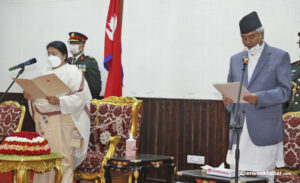
President Bidya Devi Bhandari administering the oath of office to new Prime Minister Sher Bahadur Deuba
Even otherwise, there is much media speculation about Deuba’s alleged pro-India, pro-United States proclivities.
While it, of course, remains to be seen how the prime minister of an independent, sovereign Nepal can be anything other than pro-Nepal, all thinking and patriotic Nepali citizens should be fully alive not only to the impact of surging and conflicting domestic political currents but also to the danger of Nepal being transformed into a cat’s paw for extraneous powers who may have their own separate and international agendas to pursue in Nepal.
If scrupulous care is not taken, it won’t take long, or much, to knock the bottom out of today’s frail ship of state. One therefore hopes, and prays, that those who hold the helm of power will proceed with extreme caution and clear vision, with the national interest as their guiding pole star.

Login to add a comment