








By Narayan Prasad Mishra
Bhaktapur, one of the three cities in the Kathmandu Valley, is a unique city in our country. It has got an exceptional antique beauty even now, not only with its famous historical palaces and temples but the city as a whole with its ancient residential buildings and old brick-paved roads. When I was born here in 1944, this community was ordinary in terms of economic status. No one possessed significant wealth in the city. No one was extremely poor or rich here. All had almost the same kinds of houses built with mud and bricks with the traditional tile slope roofing. All the people knew almost all living here. They had brotherly and sisterly love between them. The crime was virtually nonexistent. People were religious and God-fearing, suitable for Bhaktapur, which means the city of devotees.
I had a very loving and spiritual father and mother. They were a very devout couple deeply committed to the Hindu faith with a high value of moral and ethical principles. Being a devotee of Lord Shiva, my father displayed his devotion by doing different religious activities – 1. installed Golden Gajur (the pinnacle of a temple) at Doleshwor Mahadeva Temple, Shipadole, Bhaktapur, 2. Stonesymbole, the bull’s statue of Brass at the Mangaleshwor Mahadeva Temple at Bansa Gopal Tole, Bhaktapur, and a Shiva idol Durgeshwor Mahadeva after his name at Hanumanghat, Bhaktapur, 4. Toran, Big board of the attached idols of many different gods and goddesses at Teelmadhav Narayan Temple, Taumadhi, Bhaktapur ). I never saw and heard that Durga Prasad Mishra, my father, and Krishna Malika Mishra, my mother, ever argued with each other.
Punya Prasad Mishra, my younger brother, followed their footprints. Even now, he spends most of his time praying and worshipping Almighty God. He filed a case against the person who occupied a Shiva’s small roofless temple, deep well as well as a small plot of land located at Yalachhe Tole, Bhaktapur at the support of The Bhaktapur Municipality. His devotion to the Almighty forced him to do this though he did not have any bad feelings, enmity, or hostility against the occupier like a brother. Although he succeeded in getting the returned public land and the temple for the people through the court decision, he suffered a lot from the person and the municipality. It affected me also a lot. They took me also as their enemy though I am not. I had to face unlimited, painful hurdles from Bhaktapur Municipality in the process of getting permission for my tiny house construction in my ancestral property when Prem Suwal, the present Member of Parliament, was the Mayor. By facing all the difficulties and obstacles created intentionally, I virtually thought it would be almost impossible for me to live there peacefully. So, I dropped my idea of completing my house construction there. I do not know Narayan Man Bijuchchhe, the only leader of this town who considered me a friend or foe. I never had any argument or enmity with him. I love him as my childhood friend though we seldom see each other. He used to come to our house to have tuition from my elder brother Bhawani Prasad Mishra, one of Shree Padma High School Bhaktapur’s founding teachers. Even his uncle Surya Man Bijukchhe was a student of my brother. I remember him also coming to my house, a forgotten history of once upon a time.
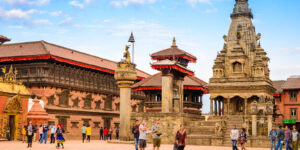
Bhaktapur Durbar Square
Men and women wore their traditional dresses – Dauro Suruwal and Kamij Suuwal for men (trouser, long shirt with sleeve or top of Nepali national dress), Sari and cholo for women (unique short top like dauro, Nepali dress, and sari). There was an extraordinary unsophisticated simplicity in life. The men’s trousers made out of ordinary cotton, not so thick material used for pants these days, would get tear and break within a few months, mainly on the knee spot and the place. People got repaired it on that spot with a piece of cloth patching and reused the trouser. Of course, somebody would visibly see the patched area. But that was not unconsidered nice and was accepted well and acceptable. My father, Durga Prasad Mishra, and elder cousin brother, Ananda Prasad Mishra, told me that some people got that spot patched even when the trouser made it more durable and robust. It showed more unsophisticated and simplicity. I remember I often wore that type of repaired and fixed trousers because of the tear in my life. I was in my Daura Suruwal outfit until I joined the University in B.S.2021.
I do not know from where it came, how it came to me, that I had a powerful sense of justice either at home or outside. I did not learn to keep quiet when someone did injustice to me or others. Honesty and sincerity were in my blood. It made me fearless, to tell the truth, and speak the mind. It made me courageous to write and speak without biased in any circumstances. I never learned to hide the fact, however cutting it would be. The philosophy of my righteousness is to help anyone whatever the way you can. Even if you cannot do so, never give pain or trouble to anyone. My books in Nepali “Prajatantra Ra Jana Aawaj, Umliyeka Peedaharu (collection of poems), and Tribhuvan Bishwabidyalaya Ra Shikchya, Tribi Kendriya Pustakalayako Gauravshali Kahani, and of course, many of my articles recently published in People’s Review represent my nature and views. After meeting and working for the Tribhuvan University Library’s cause with Shanti Shrestha, the Chief Librarian, I found the same character and qualities in her. We became a very inseparable good friend, liked each other very much, loved each other very much, and became husband and wife on May 8, 1970, which became the talk of the town.
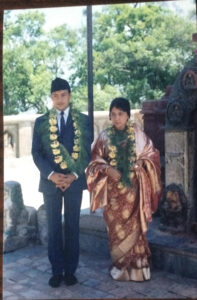
Wedding picture of Narayan and Shanti Mishra
That was not just because of the wedding of a couple working together in the same office, but also primarily because of the difference in cast, position, age. She was senior to me in all aspects- age, service, status, but we were equal in relation, thoughts, aim, ambition, more than that, in our convictions. She always thought I was elder to her in understanding the family, the society, and the world, and on the other hand, I always thought she was younger than me in understanding all these things.
Moreover, she had a high value for my knowledge, talent, guidance, and advice in her life. I, too, had the same significance from her in my life. She described it in her book “Voice of Truth.” But at that time, our marriage was almost like a revolution in the Nepali society against the country’s established social custom and tradition. That was certainly not easy to break. But we broke that tradition with courage and determination. Luckily, we had no objection from our parents – Durga Prasad Mishra, Krishna Malika Mishra and Janaki Lal Shrestha. We thanked Sirdar Rudra Raj Pandey, the Vice-Chancellor, Dr. Trailokya Nath Uprety, the Registrar, and Prof. Surya Bahadur Shakya, the Principal and the Chairman of the Library Committee. They all supported us with joy and happiness.
We worked hard with our convictions to actively develop Tribhuban University, the newly established center of higher education in the country, especially for its Library, which was known to all, our dear child. But our thoughts and convictions did not meet the century’s old tradition of flattery in the country. Because of that, our life could not run smoothly. We always got into trouble with our work. We had to face hurdles in every step of our life. My beloved wife wrote in detail in her book written in English, “Voice of Truth: The Challenges and Struggles of a Nepalese Woman”, and described fully in our book written in Nepali “Tri Bi Kendriya Pustakalayako Gauravshali Kahani Ra Hamro Sewa”. People took us as proud, arrogant, cruel, without any matter, just because of our tough stand for the cause of the University and its Library we served. We had to lose promotions in our jobs. We were left behind with all the rewards, medals, facilities provided by the organization and the country. We never got any nominated dignified jobs or positions of the organization within the University – Vice-Chancellor, Rector, Registrar, etc., or any constitutional posts in the country – Ambassadors, Member, Chairman of any organization – Planning Commission, Public Service Commission, etc.
What to talk about the expectation of a good position, we could not hold even our professional job with diligent, honest, efficient work and dedication until the University’s retirement age because of our conviction of justice and integrity. The right to work till the retirement age is the inalienable right of a citizen of a democratic country. But we lost our positions 9 and 14 years before our retirement age without any fault. What would be the most injustice to a person who is competent, active, sincere, honest, and dedicated to the nation’s service than that? But it was a justice and praiseworthy step for the Nepali Congress Party appointed Vice-Chancellor Kedar Bhakta Mathema, the person honored by the Ex-Chief Justice of our Supreme Court for her book launching program. What can we do except lament? Our country is still in the hands of a Mathema attitude. They have a party, many followers, a group, a gang, power, and can do anything they like. We have no party, no group, and belong only to the nation and the people. So, we are the helpless citizens of the country.
(To be Continued)

Login to add a comment