








By Narayan Prasad Mishra
After completing my intermediate study at Trichandra College, not even appearing in the final examination for it, I applied for a post of a junior clerk (Bahidar) advertised by the Nepal Public Service Commission. That was the time of the Nepali Congress Party Government. B.P. Koirala was the Prime Minister of the country. There was a rumour that it would be almost impossible to get a job, either low or high level, without some link or relations with that party. They had their eyes on nearly everything – job, scholarship, etc. The young Congress workers of every locality in the Kathmandu Valley seemed like the powerful government’s powerful representative. People had to be after their blessings. I was also asked to contact someone from this group. Though I knew some people among them being the native of this valley, I did not have any close contact with any party people, either the congress or the communist.
To my surprise, I passed the written and interview exam for this post without any contact with any influential person. I was posted to the Gorkhapatra Chhapakhana and was appointed as a junior clerk in 1960 (2017). There were two high officers, heads of two different section 1. Manager, the head of the administration, and the Chief Editor, the head of the editorial section. Nani Babu Acharya was the manager then, and Prem Raj Sharma, the father of Ram Raj Poudel, was the Chief Editor. I heard he was the first editor of this publication. I was in the general administration under the manager.
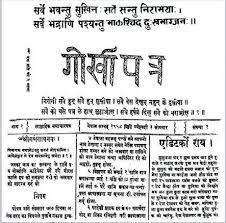 There were varieties of works under the manager – receiving the order of all printing works including the letter pads, forms, books booklets, posters from all the government offices, making it ready for delivering after printing, binding besides the routine work of Gazette and Gorkhapatra printing and distributing throughout the country. No government offices could get print any of their printing works from the private press unless they were given in writing from this Chapakhana that the press would not be able to do the printing work for them due to the heavy workload.
My assignment was in the dispatch section. The Gorkhapatra was publishing three times a week, not daily as of today. The Gazette was weekly besides some more additional issues according to the need to bring out the government notices to be published. So far I remember, in the beginning, there was about 900 subscriber of Gorkhapatra and about 500 Gazette subscriber. There was no systematic arrangement of the subscribers’ list – geographical order, alphabetical order, etc. All the subscribers’ names were listed in one sequence in one big register book, adding every new subscriber to it. The funniest thing about my job was that every day I had to copy the name and address of all the subscribers in a long piece of paper about 3-4 inches breadth, after cutting them into pieces of all individuals to paste on the Gorkhapatra and the Gazette dispatching them to the subscriber’s address every day. That was a mess. It was so boring to copy the same name, address every day – cut, sort, and paste. Not only that, those cut pieces before it pasted on the paper had to be classified according to the districts – Birgung, Biratnagar, etc. putting them in some pigeon holes made for this purpose to organize the subscriber belonging to the different districts. Because the post office wanted classified bundles of paper for each district.
I was just 17 years old then. The idea came to my mind that if the list could be made alphabetical under each district, and then if I could make the alphabetical list of all the subscribers under the district and got the list printed, the problem of copying, cutting, sorting out of the same name and address every day could easily be solved. I proposed this idea to my supervisor named Govinda Prasad Upadhyaya. When he heard it from me, he got mad with me and said, “Do not talk all the unnecessary, impossible thing. Do your work. Who would make that list?” I said, “I will, I can do it. ” Then he said, “Besides doing your assigned daily work of coping, do whatever you like. I worked on it. I made the alphabetical list in a big register that I thought about and got it printed by working many days without anybody’s interest and support. It saved three persons work. I was glad that I could solve the problem and would not have to do that coping name and address tedious work every day. It seemed they had been doing this work since the publication. I did another job. If the record were preserved, it would be a valuable historical document of the development of Gorkhapatra. But I doubt they had preserved it as we do not give importance to this kind of historical record.
During this time, I appeared in the intermediate exam and passed it. Now I had I. A. Degree. I was working as well as studying. My attention did not go to politics much. So, I did not know much about it. But I have a vivid memory of the day of 1 Poush, 2017. That was the coldest day of that time. The sky was cloudy and dark. I was in the office, enjoying my work as usual. The speech of Prime Minister Koirala was in print in my office. They were ready to dispatch. That was my duty to deliver it with the count the same day. Suddenly, we got news not to move from the office until further notice. Do not provide or send out anything outside without further notice. There was a curfew. We all were locked inside and spent the time gossiping. We did not know what to do and what was the real problem. Only around 6/7 pm we got the information we could leave the office with the office pass and had to come to the office with the same pass. I got my pass and went home, showing the pass to the security on duty.
After a few months, one day, when I was on the way to my office from my residence, I met an office friend. He said there was a reorganization (Punargathan) in the offices. “Among the officials, some are fired, and some are promoted, and some are kept as it is. “I did not understand it. So I asked why that was. The friend said it seemed, “some are rewarded, and some are punished based on the work evaluation. Who could say even you might lose the job or might get the promotion. “That is called Punargathan, he said. Then I asked him, “Do you think anyone is watching our job performance. Again, I said, “How can I lose my job as I have not done anything wrong!”. We reached our office in New Road. We came to know our manager lost the job. So, the Chief Editor Sharma was directed to work as the manager also. He became the manager as well as the Chief Editor.
We all were asked to be on the chair where we were supposed to be, not moving here and there, and told that the high officials from outside would be coming soon with our letters – letter of our reappointment to the same post, the promotion letter or the demotion letter. Until they came we would not be sure to know in which state of condition we were in that circumstance. Anxiously, we all were looking forward to seeing them. Around 2.30 pm Narayan Prasad Baskota, our Director, Ram Raj Poudel, the Deputy Director, and some other people came to our office, and we were all called to them. They called us one by one and gave us the letter of reappointment (Thamauti) and the letter of promotion (Padonnati). It seemed that the message of dismissal had already been delivered to the home address of the person. Some dismissed person was not present there. My name Narayan Prasad was called two times. But both times, the name was reached with the surname Shrestha, not Mishra. We were there two with the same name but the surname different – Shrestha and Mishra. When the first time called with that surname, Shrestha went and got his letter. When the second time called with that surname, I was confused and told them about my similar name but the surname different. That time the director Banskota asked me whether I knew Nepali grammar Rhraswa and Dirgha. I told him, “Of course I know about it. All the writings of the male name are to be Rhraswa, and the female character is to be Dirgha (Bhale jatti Rhraswa and pothi Jatti Dirgha). There was a big laugh in the gathering. Director Banskota was charmed with me. He expressed what a smart, handsome boy I was. Then again, he asked about my qualification. I told him I was doing B.A. Same time, I also said that I could not apply for the much higher post just because of under the age of 21, which was needed for the position. They were happy to hear from me. They went back that day without giving me a letter. After a few days, to my surprise, I got a letter of promotion. I had been to work for only one year. I am happy to remember that after I met him, Director Banskota never missed seeing me and enquired about me whenever he came to our office. My boss and everybody in the office was surprised to see it.
On the other hand, my supervisor, who worked for the last 5/6 years, had no promotion, and he just got a reappointment (Thamauti). He was sad. He showed his dissatisfaction with it and was ready to resign from the job. Prem Raj Sharma, our acting manager, and the Chief Editor got mad with him and asked him to resign if he wished. He left the job. I was given his responsibility also.

Login to add a comment