







NEWS COMMENTARY
 By Pushpa Raj Pradhan
Although the climate is very cold, the politics has heated the streets nationwide. The prolonged quarrel in the ruling Nepal Communist Party for the bigger portion of the cake finally resulted in the dissolution of the House of Representatives, sending his rival group to the streets by Prime Minister KP Sharma Oli. Oli’s compulsion was that if he had delayed on initiating his action, he was sure to face a no-confidence motion in the parliament.
Oli had assured to his colleagues in the ruling party that he would hand-over the party chairmanship from the upcoming unity national convention of the party and also handover the PM’s post after the new session of the House of Representatives. However, Oli’s rivals had no patience to wait till the party national convention and the new session of the parliament, thus far, now, they are in the streets demanding reinstating the HoR at any cost.
Still, we have to wait for the Supreme Court verdict on the Prime Minister’s action. As the issue of dissolution of HoR is under the Court’s jurisdiction, different political parties including Oli’s rivals within the ruling party and the foreign-sponsored citizens’ group are demonstrating in the streets to influence the court decision. Indeed, this is a foul game.
Verities of actors, verities of demands:
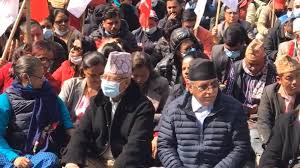
Since the dissolution of the HoR, Oli’s rival within the party known as NCP Prachanda-Nepal faction is organizing demonstration and mass rallies demanding reinstating of the HoR at any cost against the regressive move of the PM. They believe, HoR should be restored by the Court to save the achievement of the 2006 April uprising.
The main opposition party Nepali Congress has also launched nationwide agitation. It has opposed the “unconstitutional” move of the PM and welcomed a fresh election.
The Janata Samajbadi Party, the other party in the demonstration, is demanding for re-writing the constitution. The party is less interested in the restoration of the HoR or a fresh election.
The Citizens’ Group in agitation has opposed the dissolution of the parliament saying it an unconstitutional and regressive act and demanded the restoration of the parliament to save “loktantra” (present style of democracy).
On the other hand, the Rashtriya Prajatantra Party has welcomed the PM’s decision to go for a fresh election. The party has defined the PM’s action as his prerogative in the parliamentarian democracy.
Maybe, tomorrow, other groups may surface in the streets with other demands.
Elections unlikely on given dates:
There left less than 90 days to conduct the election. Still, the constitutional bench in the Supreme Court is continuing hearing on the case filed against the dissolution of the parliament. If the SC will move through a fast track, it may give a verdict by mid-February only. Even if the court will approve the PM’s action, the Election Commission cannot hold the election on the government set dates. Therefore, the election can be postponed until the festival seasons is over or say only after the Chhat festival i.e. by mid-November as conducting elections is almost impossible during the rainy season.
EC in dilemma:
According to the interim statute of the Nepal Communist Party, until the unification national convention, all the decisions in the party will be made jointly by the two chairmen and they will be endorsed by the party general secretary. Any decision taken by a single chairman will be illegal. Therefore, the Election Commission has not been able to recognize split in the NCP.
The existing constitution has clearly mentioned that a newly established or unified party cannot split without completing five years of its establishment. In this regard, except the Nepali Congress, other political parties cannot split until they complete five years of establishment. To note, the present constitution has become more complicated as it is not written by the constitutional experts but written by the political actors, who believe the constitution is the best-ever in the globe!
There are many errors in the constitution, and thus, there is a legal hurdle to accept the split in the NCP. On that case, both the groups should knock the court’s door for a verdict on the party split or both the splinter groups should announce reunification. The next option left for the EC could be suspending the party for the time being.
On this case, both the factions cannot use the party name and also the election symbol. They should contest elections with other names and election symbols.
More importantly, Oli’s rival groups are challenging to topple down Oli through a people’s movement. Therefore, these groups in the streets may not take part in elections, perhaps, will try to intensify the agitation.
In such a situation, the declaration of an emergency period cannot be discarded. Also, the possibility of foreigners playing their own game cannot be discarded.

Login to add a comment