








By Narayan Prasad Mishra
In Europe and America, when you do something for someone, you get thanks without delay. That is their culture. In small or big, no matter, you get thanks. And you do something useful – in speaking, in writing, in doing, in helping, or in any other things you get appreciation. Very nicely, they appreciate you. Because of that, you get inspiration to do something good for others. Not only thanks and gratitude, but they do also make comments to show your weakness and strength in your action – speaking, writing, anything. The children learn these things even from childhood at home. They know it from their parents and seniors.
In the same way the course books, the textbooks are written. They also learn these things in school. These facts are always with their life. This culture reflects anywhere – school, classroom, playground, work, meeting, seminar and conferences, writings – papers, articles, books, etc. They do not hesitate to appreciate you. It seems they do not feel that appreciation would harm your superiority. What we often experience in our country as if the gratitude makes you inferior.
In this context, I remember the incident of my inspiration. That was in 1974. Shanti Mishra, my late beloved wife, and I being the only internationally known librarians, the Editor of Encyclopedia of Library and Information Science, University of Pittsburg, Pennsylvania, the USA, requested an article on Nepali libraries. They sent a sample copy of the item already written in Chile, the country of South America, to follow for our writing. Alphabetically this country’s name comes before Nepal. We did not see any introduction about that country in that article that we thought would be better for understanding. Not only that, but the given information also, we felt it was not well organized and classified. We wrote the article making our format, not based on the sample copy with the country’s introduction. That was against the direction of the Editor and the sample. We sent the article the way we thought better. We were not sure that they would accept our writing. We were thinking of rewriting the item if needed after their response. To our surprise, the Editor of this world-renowned Encyclopedia wrote the following letter on 5 September 1974, considering our that article a model. We were thrilled. We experienced tremendous inspiration in writing. I hardly expect this culture from the people in our country when someone is in power. Here the person in power always thinks he is omniscient. He knows everything. They had that kind of praiseworthy courage to accept their weakness and appreciate your betterment. I think that is also a reason Europe and the USA are at the peak of modern development.
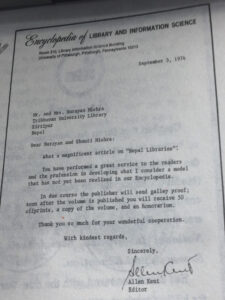
In the same context, I am happy to mention here that I had forwarded some of my articles recently published in the People’s Review — 1. A tale of a Missionary Doctor and an Abandoned Child 2. A System of Bhagabanda 3. Disfigured Democracy and Nepal, etc., to some of my Nepali as well as American friends. I did not hear anything from Nepali friends as we have no culture to appreciate or comments on. Whereas I quickly got a response from my American friends. It may be interesting to quote some of the comments just for an example.
Regarding my article A Tale of a Missionary Doctor…,” Dick Wolfsie, humorous writer and well- known T.V. Programme presenter, wrote:
Hi Narayan,
I just finished your dramatic story about the little orphan girl and her relationship to your family. What a beautiful story, worthy of a movie. Thank you for sharing it. Terrific!
Dick Wolfsie, Indiana.
Our library colleague and sisterly friend Nancy W. Hatch, the Peace Librarian to TUCL, Kathmandu, wrote:
Dear Narayan,
What an amazing story! I don’t remember ever hearing about Laxmi before. It was also good to hear more about Shanta Bhawan, where our Shanti was born.
Thank you for sharing the story of Laxmi – I will share it with Pat, Robert, and Sandy – and I think our Shanti, Kamala and Allison would also like to read it.
We think of you often and treasure our friendship with you and our beloved Shanti didi. We are grateful that you are with Pragya and family and not alone in Nepal.
Love, Nancy
Regarding A System of Bhagabanda, Austra Gaige, a counselor, Pennsylvania, a long time friend, who served Nepal a long time ago, wrote:
Dear Narayan,
I am so happy that you are actively writing and bringing attention to the problems which face Nepal and how those have affected people like you and Shanti. The two of you are just the kind of people that a country like Nepal needs so desperately. Sadly, Shanti no longer has an active voice, but you do and you are using it. I think she would be proud…
Our dear friend, late Dr.Frederick Gaige, the Fulbright Professor to Nepal, spouse of Austra Gaige, is well-known as the author of the book Regionalism and National Unity in Nepal to Nepal and abroad.
Another friend Amy Tibesar, a social worker, Indiana, wrote:
I can’t believe the caste and bhagabanda system still going on. It not only makes me endlessly grateful to live in America but incredulous and wondering how/what it would take to make a change within Nepal. Would it take one particularly powerful leader, a revolution, what? Such a heavy topic!
Another friend Pat Oakes, a teacher and educational, Texas Wrote:
You have been working hard, Narayan, to write such an extensive article on corruption in Nepal and how it impacted your life and Shanti’s. It is certainly notably a story of injustice, and it is also a story of the loss of your goodwill and talent that would have benefitted your beautiful country. Thank you for sharing this. Love, Pat Austin, Texas.
Regarding A Land of Dishonesty, our friend Robert Palmer, the Fulbright Librarian to Nepal, New York Wrote:
Read your very moving piece, causing me to think that your forceful prose, “Truth to power”, could be used here where many politicians remain in fear of, and beholden to, Donald Trump. He lost reelection but is incapable of admitting to failure. Should point out that I am an independent, never a member of the Democratic or Republican parties. Have always voted for Democratic Presidents, but also have voted in the past for Republicans in lesser offices.
Another friend Mary Ellen, Indiana wrote:
Narayan,
I just read this latest article. Very interesting and your ability to write so beautifully in the English language is impressive. I am curious about the publication, People’s Review. Is it published and distributed in Nepal? And, if so, why is it in English?
I mentioned and referred to my book Tribhuvan Biswabidyalaya Ra Sikshya and several of my published articles on the National Education System Plan, 1971, in many of my present writings. The concerned people used them for the reform. I know the many education commissions formed later on had studied and used them. Not only they were ungrateful to give me some credit, but they were also reluctant even to mention my book and the articles in their references because we have an unappreciative culture. In Europe, the USA never does it. In those countries, people get inspiration from society for any appreciable work. That is why we see the charity and donation from the people in these countries for educational and health or other areas – schools, colleges, universities, libraries, hospitals, anywhere, resulting from it. We see everywhere universities, libraries, hospital buildings built by donations. There are two crucial things – 1. Your charity and assistance are not misused. 2. You are appreciated for your contribution. They make you in different ways you are permanently remembered for the cause of your gift. Whereas we have always doubt of the proper use of our donation in our country as we often see misuse than the appropriate service. We had the well wish to donate some of our land property worth millions of rupees for a good cause. As we could not easily do this work because of our doubt, the time passed, and my wife left this world not fulfilling the desire. I have been thinking still to do it. I am in great dismay. I do not know whether I will be able to do it as we see everywhere, misuse, and corruption. Politically our country is in a mess.
All the countries- small or big, have some people who did some notable good things for the nations. Similarly, we, too, have many people who made remarkable contributions in making the country. Not only kings and queens, but there are also hundreds of thousands of people in different fields — education, economics, planning, administration, diplomacy, engineering, health, army, police, journalism, mass communication, politics, social service, literature, etc. We are glad we also could do some work in the library and educational field. But the most unfortunate thing in our nation is that we have no culture of gratefulness. What to lament about not remembering and appreciating the professional personalities we are condemning the historical figures who made this country’s existence — King Prithvi Narayan Shah, the creator of consolidated Nepal; King Tribhuvan Bir Bikram Shah, the hero of Democracy; King Mahendra Bir Bikram Shah, the impressive figure of self-respect, pride, the dignity of the nation and the remarkable model of the infrastructure of this country. They are not appreciated. Their valuable contribution to the growth and development of this country is forgotten. Not only that, we all know the ungrateful people broke and dismantled some of their statues in different parts of the country. Instead of establishing a culture of gratefulness for the people’s assistance – high or low if we encourage the culture of ungratefulness kritaghnata, it is sure that we are going to have a terrible fall and downfall of our beautiful country. The history of this nation will curse us.
narayanshanti70@gmail.com

Login to add a comment