Author: people

  • Oli approves Rs 64 billion project in Jhapa

    Kathmandu, 3 August: The Investment Board Nepal has approved the investment of around Rs 64 billion for the construction of the China-Nepal Friendship Industrial Park in Damak, Jhapa.The 39th meeting of the Board held under the chairmanship of Prime Minister and Board Chair, KP Sharma Oli, at the Office of the Prime Minister and Council of Ministers, Singha Durbar, on Friday, decided to give permission to Damak Clean Industrial Park Pvt. Ltd (DCIP) to prepare  detailed project report of the China-Nepal Friendship Industrial Park to be constructed at the investment of Lhasa Economic and Technology Development Zone Jing-Ping Joint Creation Construction Project Development Co. Ltd.

    Approving the propose of the Multi Model Logistics Park in Biratnagar, the meeting also decided to grant permission to CG Logistic Pvt Ltd to carry out study without burdening Nepal government with financial liability. An agreement had reached between CG Logistic Pvt Ltd and Sharaf Group of UAE for the development of the project on the occasion of Investment Summit-2019. The meeting approved the proposed Railway Linked Private Freight Terminal project to be constructed at Janakpur and decided to give permission to the Green Infrastructure Pvt Ltd to carry out study without burdening Nepal government with financial liability.

     The Fuji Electric Company Ltd of Japan having the joint venture with Nebras Power Qatar Holding LLC, and the HIDCL having the joint venture with the Power Construction Corporation of China Ltd have been demanded the sealed proposals for the reservoir based Tamor hydropower of 756 MW capacity. These companies were selected after the evaluation of the letter of intent received from among various construction companies.

    People’s News Monitoring Service


  • Biplav desperately yearning for dialogue

    Kathmandu, 2 August:  Politburo member of the Netra Bikram Chand aka Biplav led- banned group Mohan Karki has said there was no alternative but to hold dialogue between the government and his party.

    According to a RSS dispatch, Karki laid emphasis on exploring solution through peaceful means reasoning that the country getting into violence would not benefit anyone.

    Karki shared that he was in favour of dialogue and was arrested while making effort for the same. He said the state should be serious for this. The political work direction of the party is united people’s revolution and not guerilla warfare, he clarified. “The unified people’s revolution is to integrate farmers, workers, middle class and national capitalist group and conduct people’s movement. Some of the colleagues are nurturing misconception and opting to take the movement to guerilla war”, he added.

    He informed that he had suggested his party general secretary Chand to mend the party working style, take into confidence the urban-centric middle class and render relief and put national awareness drive as per the work direction. He also admitted some mistakes on part of his group. Police had arrested him from Lalitpur on 15 March for alleged involvement in violent activities led by Chand group.

     People’s News Monitoring Service


  • Partnership endorsed between Sunrise Bank and Women’s Chamber of Commerce

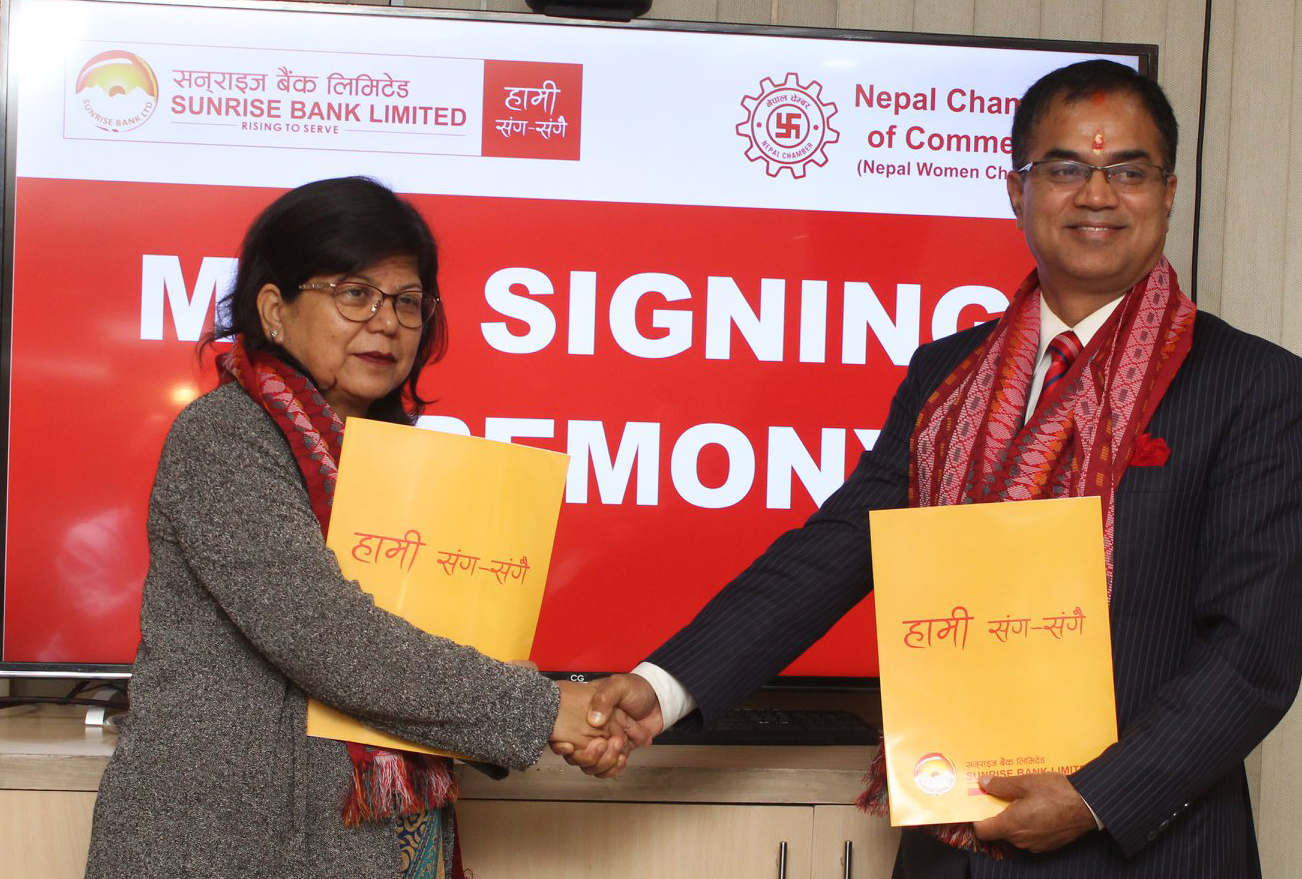
    Partnership endorsed between Sunrise Bank and Women’s Chamber of Commerce

    Kathmandu, 2 August: Sunrise Bank Ltd and Women’s Chamber of Commerce under the Nepal Chamber of Commerce have inked an agreement for providing advisory services on banking, accounting and taxation.

    The agreement was signed by Bank’s chief executive officer Janak Sharma Poudel and chairman of the Chamber Mrs Urmila Shrestha amidst a function. Under the agreement, the Bank will provide advisory services on banking, accounting and taxation to all the women entrepreneurs associated with the Chamber.

    People’s News Monitoring Service

  • ‘No arbitrary foreign junket’

     Kathmandu, 2 August: The Ministry of Federal Affairs and General Administration has decided to restrict the uninformed foreign visit of the local level employees.

    Issuing a three-point direction to all district coordination committee and local levels on Thursday, the Ministry directed the local level officials to not hold foreign visit if their accommodation and travel fare were not borne by the organizing agencies abroad.

    In a bid to control illogical foreign trip, Foreign Visit Directive-2075′ and ‘Directive on Foreign Visit of Local Level Employees- 2075’ have been endorsed and one has to adhere to it, according to the directive.

    Moreover, for the Ministry approval, the officials in a group of three persons are required to submit the essential documents at least 15 days before the commencement of foreign visit. Similarly, for the programmes which are must necessary for the local levels from the viewpoint of technical and economic assistance, a group of two persons could be made and applied for the permission from the Ministry.

     People’s News Monitoring Service

  • By-elections in November

    Kathmandu, 2 August: The political parties have suggested the Election Commission of Nepal (ECN) to hold by-election in the Nepali month of Mangshir (Mid-November to Mid-December) for the vacant posts of local level, provincial assembly and House of Representatives.

    At a discussion programme organized by the ECN on Thurday, Chief Election Commissioner Dinesh Kumar Thapaliya briefed the participants about the provisions regarding by-election and preparations undertaken by the Commission for the same. Commissioner Ishwor Prasad Poudel shed light on the objectives of the discussion programme and legal provisions for holding by-election in Nepal.

    Representatives from various political taking part in discussion suggested Mangshir month would to be apt for holding by-elections. They also pressed for strict implementation of the election code of conduct and to hold the by-elections for all the vacant posts all at a single time, according to the Commission.

    Furthermore, the participants drew the attention of the Commission towards the use of electronic voting machine (EVM) and put in provision wherein the Nepalis abroad could also cast their votes.

    Altogether 18 political parties representing in the local units and House of Representatives and provincial assembly were invited to the event where Nepal Communist Party, Nepali Congress, Rastriya Janata Party, Federal Socialist Forum, Rastriya Prajatantra Party and Naya Shakti Nepal among others had marked their presence.

    People’s News Monitoring Service

  • Week-long Nepal photo exhibition in Beijing

    Kathmandu, 2 August: The Embassy of Nepal organized ‘Nepal Photo & Painting Exhibition 2019’ in Beijing yesterday, to mark the 64th anniversary of the establishment of diplomatic relations between Nepal and the People’s Republic of China.

    Several dozens of photographs and paintings by Nepali and Chinese artists were displayed at the Exhibition, together with traditional Nepali artworks and handicrafts. The event also featured performances by Nepali students and Chinese artistes, according to a statement from the Embassy of Nepal in Beijing.

    Around 150 guests including representatives of the Government of the People’s Republic China, ambassadors and members of the diplomatic community, organizations and agencies related to art, culture and people-to-people exchanges, business enterprises, the media and friends of Nepal participated in the event.

    Earlier, welcoming the guests, Ambassador Leela Mani Paudyal shed light on the unique and exemplary relations of trust, friendship and co-operative partnership between Nepal and China, and highlighted the important achievements made during the past year in further enhancing bilateral relations, including the first State Visit to China by the President of Nepal in April 2019. He expressed the confidence that Nepal and China would continue to work hand-in-hand to meet the development aspirations of their peoples, and to attain a just, inclusive and peaceful global order.

    Chairman of China International Culture Exchange Foundation Zuo Zhongyi extended congratulations on the occasion of the anniversary of diplomatic relations between Nepal and China, and expressed the hope that the relations between the two countries will continue to grow and flourish in the future.

    President of Federation of Handicraft Association of Nepal, Surendra Bhai Shakya, Seal Carver & Sinologist, Zhao Zengfu, Photographer Su Xue and Secretary General of China International Culture Exchange Foundation Wang Xuejun also spoke at the programme.

    The event was organized with the support of China International Culture Exchange Foundation, Foreign Affairs Office of Sichuan Province, Luxehills Art Museum and Art Sino Cultural Development Committee. The Exhibition will remain open for the public until 7 August, adds the Embassy.

    People’s News Monitoring Service

  • Teenager dies while playing games on charging mobile

    Kathmandu, August 1: A boy died when he received electric shock at Trishuli chowk of Letang municipality-3 in Morang today.

    The deceased has been identified as Saujan Rai, 15, son of Padam Bahadur Rai. According to the State-1 Police Office, Biratnagar, the incident took place when Saujan received electric shock while playing games on charging mobile.

    People’s News Monitoring Service

  • NCell, NTC towers targets of Biplav’s sabotage

    Kathmandu, 1 August: Banned rebellious Netra Bikram Chand (Biplav)-led group has torched around two dozens of telephone towers of Ncell and Nepal telecom at different districts of the country.

    According to the Nepal Police Headquarters, 22 telephone towers of Ncell and one telephone tower of Nepal Telecom have been torched.Biplav-led group had torched and vandalized the telephone towers and a person has been arrested on the charge of his involvement in Arghakhanchi incident.

    Twenty-two Ncell towers of different places of Kapilvastu, Kailali, Jhapa, Dadeldhura, Doti, Dhading, Parbat, Nawalparasi (East), Panchthar, Banke, Baglung, Morang, Myagdi, Rupandehi, Lalitpur, Sindhupalchowk, Achham, Salyan and Makawanpur districts were torched and damaged. A telephone tower of Nepal Telecom at Paneni municipality-5 in Arghakhanchi district was set on fire, said police.

    People’s News Monitoring Service

  • Sanskriti International School, first school in South Asia to bag awarded with prestigious IPC Accreditation

    Kathmandu, 1 August:  Sanskriti International School is awarded with most prestigious International Primary Curriculum Accreditation and has become the first international school to get accredited in South Asia by IPC, UK. This accreditation is provided by Fieldwork Education UK for those Schools who follow comprehensive, thematic, creative curriculum with a clear process of learning and specific learning goals for every subject, encouraging personal learning. With the presence of IPC in 92 countries worldwide in over 730 schools till date only 17 schools have received IPC accreditation and Sanskriti International School is among one of the accredited Schools.

    For IPC Accreditation, school has to go through Fieldwork Education’s rigorous self-review process, culminating accreditation visit and presentation of external view for continued and focused improvement in learning. This accreditation is valid for 3 years and is renewed with the same process.

    Sanskriti International School has been following International Early Years Curriculum (IEYC), International Primary Curriculum (IPC) and International Middle Years Curriculum (IMYC) along with National Curriculum to improve learning. Further, Sanskriti International School aims at improving quality of education through child centered learning to build leadership qualities changing traditional educational system in Nepal.

    Chairman of Sanskriti International School,  Ranjit Acharya shared, “We are humbled to receive prestigious IPC Accreditation by Fieldwork Education, UK. Being among only 17 accredited schools in the world from IPC UK is a pride moment for all of us in Nepal. Sanskriti’s leadership team and entire fraternity of teaching staffs have put in tremendous efforts to achieve this certification. This is a great feat that Sanskriti within its first decade have become first International accredited school in whole South Asia.”

    Diptee Acharya, Director, Sanskriti International School said, “I am extremely proud and elated that Sanskriti has been awarded with the prestigious IPC accreditation. The journey which we took five years ago has been fruitful not only for the students but for the leaders, teachers and the school community as well! Despite the hurdles and challenges faced in our daily lives Sanskriti being a Nepali school has reached a world class education of global standard. We feel that with this achievement we would like to extend our learning and experiences with the wider educational community in Nepal.”

    Gregory Biggs, Divisional Director, Fieldwork Education, UK stated, “We are very happy to see the quality of standard maintained by Sanskriti International School in Nepal. They have been accredited as International School by rigorous process of high standard evaluation process by our team of evaluators, we are happy to welcome them in our list of 17 accredited schools.”

    Sanskriti has achieved this accreditation with the complete Nepali team of faculty and management, excelling in all the parameters set forth by IPC, UK. Sanskriti International School is creatively implementing IPC skills in to curriculum prescribed by Ministry of Education, Nepal. “This approach will help prepare 21st century students for the new emerging global world. We are blending IPC based on progressive education with government prescribed curriculum and preparing our students as global citizens” said  Diptee Acharya.

    People’s News Monitoring Service


  • Nepal and China ideal partners in development

    Nepal and China ideal partners in development

    By Leela Mani Paudyal

    Nepal and China established diplomatic relations on Aug 1, 1955. Ever since, the successive leaderships of the two countries have cultivated bilateral relations for mutual benefit.

    Nepal and China also share common aspirations for peace, prosperity and development, and enjoy good neighborly relations based on the five principles of peaceful coexistence. Amity, goodwill, sincerity, and trust are the hallmarks of our bilateral relations.

    Nepal remains firm in its one-China policy, while China has remained a major development partner of Nepal including in the fields of infrastructure, transport, energy, health, education, reconstruction and human development.

    China has made great strides in economic development and social transformation, including poverty alleviation. Thanks to its development, China has also made great contributions to the world economy. It has also been playing a significant role in shaping the global agenda for peace and development. Further, China has offered to share its expertise and resources with developing countries for common benefit. Which will greatly help a country such as Nepal.

    The two countries’ history of interactions and exchanges is long. Scholars such as Buddha Bhadra of Nepal and Faxian and Xuanzang of China linked the two countries through philosophical exchanges from the 5th to the 7th century. Nepalese artistes contributed to painting one of the world’s most precious grottoes, at Dunhuang in Gansu province, in the 8th century. And Araniko and his team built several stupas and Buddha’s images in China, including the Great White Pagoda (Bai Ta Si) in Beijing and Shanxi province in the 13th century.

    Our relations have continued to deepen and expand over centuries, and gained further momentum after the establishment of diplomatic relations in 1955. Bilateral ties reached a new height in April last year when President Bidya Devi Bhandari paid a state visit to China in April. Apart from meeting with President Xi Jinping, she witnessed the signing of important bilateral agreements including Transit Transport Protocol and cooperation in quality standard. She also took part in the Second Belt and Road Forum for International Cooperation, which issued a statement for jointly developing the Belt and Road Initiative that reflects Nepal’s development aspirations.

    China was the top source of foreign direct investment in Nepal, and the second-largest source of tourism last year. And with several agreements and memorandums of understanding signed to deepen Sino-Nepalese cooperation, 2018 was a significant year for strengthening overall bilateral relations.

    In recent years, the Nepalese government’s most urgent task has been to build institutions, set development goals and mobilize resources to achieve them. Nepal has initiated various reform measures to attract investment and foreign technology in order to meet the development aspirations of the Nepalese people. The government has set development targets for building major infrastructure, including railways, roads and airports.

    While Nepal is using internal resources to the maximum to realize those goals, the support of friendly countries and the international community will be of crucial importance to Nepal’s development endeavors. In this respect, Nepal’s cooperation with China is of great value and substance. Since China has the experience of lifting more than 700 million people out of poverty and realizing fast-paced economic development, it is an important partner-in-development for Nepal.

    The two sides have been working closely to develop infrastructure and improve connectivity. For diversifying and boosting land-locked Nepal’s international trade, transit, investment and tourism, railway connectivity is of vital significance. Also, Nepal has not been able to fully tap the huge potential of hydropower, new energy, agriculture, and herbal and traditional medicine-areas in which China has enormous expertise, and therefore the ability to support its neighbor. And since Nepal’s socio-economic uplift would contribute to regional growth and stability, Sino-Nepalese development cooperation is a win-win proposition.

    China advocates equality, inclusive development, multilateralism, and a rules-based world order. Similarly, Nepal supports multilateralism, and economic cooperation that is just and inclusive, and attributes responsibility to a country according to its capacity. Nepal and China are ideal development partners, for they are committed to fulfilling the aspirations of their peoples, and building a just, inclusive and peaceful global order.

    (The author is ambassador of Nepal to China.)

    (China Daily)